
TL;DR
Jira Service Management (JSM) pricing starts at $0, but the plan you actually need for incident management is Premium at $51.42/agent/month. That is a 158% increase over what OpsGenie Standard users were paying at $19.95/user/month. For teams migrating from OpsGenie who want the same workflows at a more affordable price, Spike is the closest replacement. It covers on-call scheduling, escalation policies, and alert routing from $7/user/month, with built-in status pages included on every plan. Spike also offers OpsGenie users 50% off their first six months.
OpsGenie earned a loyal following among DevOps and SRE teams because it had simple on-call scheduling, solid alerting, and a no-nonsense interface. Pricing was straightforward too.
But Atlassian stopped new OpsGenie sales on June 4, 2025, and the product is now in maintenance mode. Full shutdown is on April 5, 2027.
Atlassian’s official recommendation is to migrate to Jira Service Management (JSM). JSM is a broad ITSM platform, not a purpose-built incident management tool. That distinction shows up in the pricing.
This post breaks down every JSM pricing tier and the hidden costs that inflate the real bill. It also covers how JSM compares to Spike for incident management teams making the switch.
What is Jira Service Management? (And how is it different from Jira Software?)
Before diving into the pricing, it helps to understand the difference between JSM and Jira Software. OpsGenie migrators often land on the wrong one and get confused by the pricing.
Jira Software is the project and issue tracker used by engineering teams to manage sprints, bugs, and feature work. Jira Service Management ($0–$51.42/agent/month) is the ITSM platform used by IT and operations teams for service requests, incident management, and on-call alerting. They share a platform but are priced and sold separately.
OpsGenie was a standalone alerting and on-call tool. But Atlassian is deprecating OpsGenie and moving its incident management capabilities into JSM. The result is a platform that now has incident management features, but was not designed around them the way OpsGenie was.
In 2025, Atlassian repackaged JSM into a bundle called the “Service Collection,” combining JSM, Customer Service Management, Assets, and Rovo under one subscription. The per-agent pricing for JSM has not changed with this rebundle. The fees in this post refer to JSM standalone throughout.
How JSM pricing works: Per-agent, not per-user
JSM bills per agent, not per user. An agent is anyone who handles tickets or manages incidents. Employees who submit requests or receive status updates are not counted and do not affect the cost.
In practice, a 200-person company with 15 on-call engineers pays for 15 agents, not 200. The cost does scale directly with the size of your ops or incident response team, though, and those teams tend to grow.
Jira Service Management (JSM) pricing tiers (2026)

JSM has four pricing tiers. Most OpsGenie migrators will need Premium, since that is the only tier that fully replicates what OpsGenie Standard included.
| Plan | Price | Best For |
|---|---|---|
| Free | $0 | Teams of up to 3 agents evaluating JSM |
| Standard | $20/agent/month | ITSM and helpdesk teams that don’t need advanced incident management |
| Premium | $51.42/agent/month | Teams migrating from OpsGenie who need full incident management |
| Enterprise | Custom (annual only) | Large orgs that need status pages, unlimited automations, and multi-site governance |
Free plan ($0)
The Free plan covers up to 3 agents. You get on-call schedules, incident templates, and basic alerting. It works for very small teams evaluating JSM. However, the 3-agent cap becomes a limitation for most incident response teams.
Standard plan ($20/agent/month)
Standard covers on-call scheduling, escalation policies, and basic alerting. At $20/agent/month, it is almost identical in price to OpsGenie Standard at $19.95/user/month. But the feature set is not equivalent.
OpsGenie Standard included post-incident analysis, stakeholder notifications, and 1 year of alert data retention. JSM Standard drops all three. These gaps matter for teams that used OpsGenie beyond basic alerting.
Premium plan ($51.42/agent/month)
Premium is where JSM closes the gap with OpsGenie Standard. You get stakeholder notifications, post-incident reviews, and AIOps capabilities. Alert data retention extends to 3 years.
This is the tier most OpsGenie migrators will need to replicate what they had. The cost is $51.42/agent/month, a 158% increase over OpsGenie Standard.
Enterprise plan (custom pricing)
Enterprise is the only JSM tier that includes status pages and SSO. It adds unlimited automations, up to 150 Atlassian sites, advanced admin controls, and enterprise-grade identity and access management. Monthly billing is not available. Based on published data, it starts around $157,000/year for 800 agents.
On Standard and Premium, SSO requires Atlassian Guard at $4.20/user/month. For a 25-agent team, that is an additional $1,260/year. Status pages are not available at any price below Enterprise.
Key point: JSM Standard costs nearly the same as OpsGenie Standard but drops post-incident analysis, stakeholder notifications, and alert data retention beyond 1 month. Replicating OpsGenie Standard’s full feature set requires JSM Premium at $51.42/agent/month, a 158% price increase.
JSM add-on costs that OpsGenie migrators should know about
The per-agent price is not the full story. Here are the additional costs OpsGenie migrators are most likely to run into:
- Atlassian Guard / SSO: SSO is not included in Standard or Premium. It requires Atlassian Guard at $4.20/user/month. For a 25-agent team, that is $1,260/year on top of the base subscription.
- Status pages: Status pages are only available on Enterprise. There is no add-on at Standard or Premium. If your team needs a status page, the choice is Enterprise or a different tool.
- Setup and training: Most teams need 1–2 weeks to configure JSM to match their existing workflows, plus 2–4 hours of training per user. For OpsGenie teams used to a straightforward setup, this is a meaningful time investment.
Key point: SSO costs an additional $1,260/year for a 25-agent team on Standard or Premium. Status pages require upgrading to Enterprise.
From OpsGenie to JSM: The real cost increase
OpsGenie had two main tiers relevant to incident management teams. Essentials covered basic alerting and on-call scheduling at $9.45/user/month. Standard added stakeholder notifications, post-incident analysis, and deeper incident management at $19.95/user/month.
JSM Standard ($20/agent/month) is nearly identical in price to OpsGenie Standard but drops several features OpsGenie Standard included. To get those back, most teams need JSM Premium at $51.42/agent/month.
| Team Size | OpsGenie Standard (annual) | JSM Premium (annual) | Cost Increase |
|---|---|---|---|
| 25 members | $5,985 | $15,426 | +$9,441 (+158%) |
| 100 members | $23,940 | $61,704 | +$37,764 (+158%) |
| 250 members | $59,850 | $154,260 | +$94,410 (+158%) |

For teams on OpsGenie Essentials, the jump is steeper. A 25-person team paid $2,835/year on Essentials. The equivalent JSM Premium subscription is $15,426/year. That is a 444% increase.
Key point: JSM Standard costs nearly the same as OpsGenie Standard but is not a like-for-like replacement. Most OpsGenie migrators will need JSM Premium, which costs 158% more per year than OpsGenie Standard and 444% more than OpsGenie Essentials.
Spike: A purpose-built JSM alternative for incident management teams
For OpsGenie teams looking for the closest replacement, Spike is the best option. It is a dedicated incident management and on-call tool built for DevOps, SRE, and IT teams. Its on-call schedules, escalation policies, alert routing, and multi-channel notifications all map directly to what OpsGenie users are familiar with.
Unlike JSM, Spike is a dedicated incident management platform, not a broader ITSM tool. It starts at $7/user/month, includes status pages on every plan, and takes 1–2 hours to set up.
Here is how Spike compares to JSM in a nutshell:
| JSM | Spike | |
|---|---|---|
| Starting price | $20/agent/month (Standard) | $7/user/month (Starter) |
| Full incident management | Premium required ($51.42/agent/month) | Included on all plans |
| Status pages | Enterprise only | Built-in on all plans |
| SSO | Atlassian Guard add-on ($4.20/user/month) | Enterprise only |
| Delivery channel per escalation step | Not supported | Supported |
| Slack @here / @channel mentions | Not supported | Supported |
| Email acknowledgment by reply | Not supported | Supported (#ack / #res) |
| On-call activity log | Not available | Available on all plans |
| Setup time | 1–2 weeks | 1–2 hours |
And here are Spike’s pricing tiers:
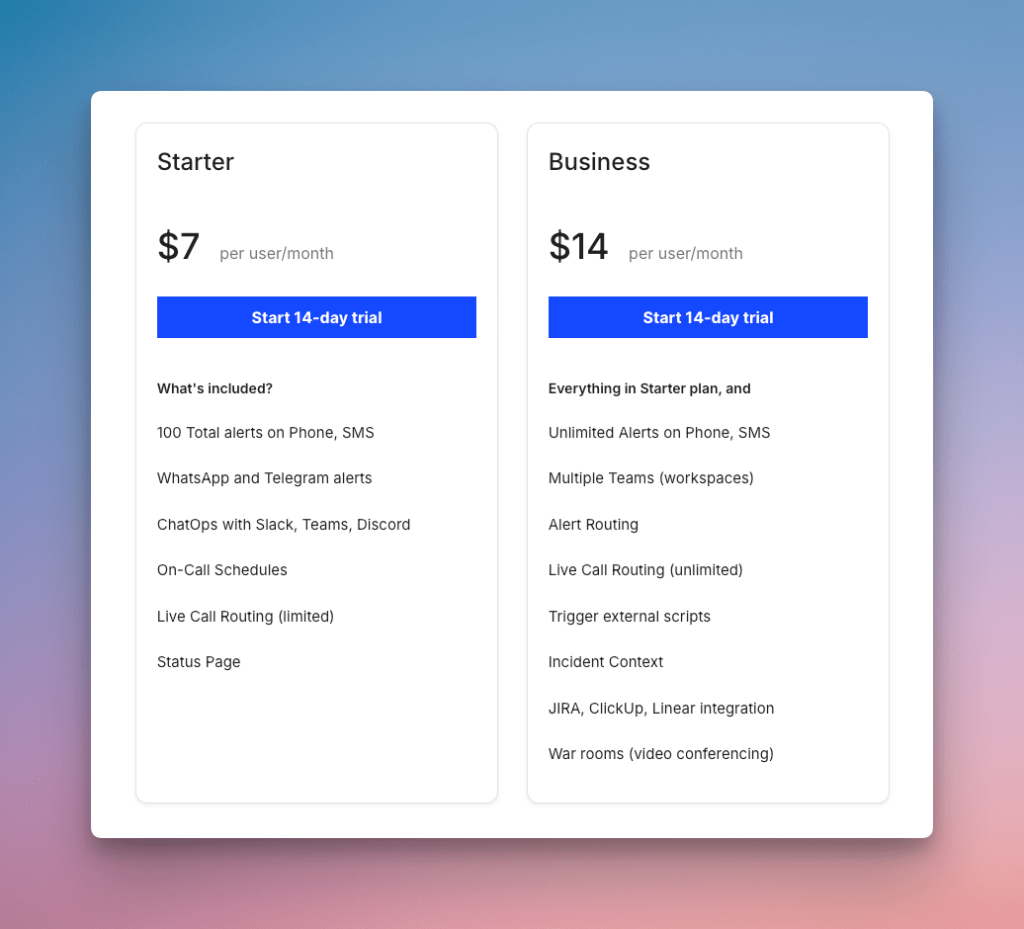
Starter plan ($7/user/month)
The Starter plan includes on-call schedules, escalation policies, basic alerting, multi-channel notifications (100 combined phone and SMS alerts, unlimited WhatsApp and Telegram). It also has Slack and Microsoft Teams integration, and a built-in status page. So, all core incident management features are included with no separate charges.
Business plan ($14/user/month)
Business adds unlimited phone and SMS alerts, multiple teams, alert routing, and war rooms for video collaboration during incidents. It also includes integrations with Jira, ClickUp, and Linear. This is the tier most OpsGenie Standard users land on.
Enterprise plan (custom pricing)
Enterprise adds SSO, a dedicated support channel, live call routing managed by Spike, and tailored incident insights. Plus, priority feature requests. Pricing is custom but typically around $15/user/month.
Migration offer: OpsGenie users get 50% off their first six months on Spike. That brings the Starter plan to $3.50/user/month for the first six months, roughly a third of what OpsGenie Essentials cost.
Key point: Spike covers everything OpsGenie offered, starts at $7/user/month, and includes built-in status pages on every plan. No add-ons required for core incident management.
Cost savings with Spike vs. JSM
Here is what the cost difference looks like in practice, comparing JSM Premium against Spike Business on an annual basis:
| Team size | JSM Premium (annual) | Spike Business (annual) | Annual Savings |
|---|---|---|---|
| 10 members | $6,170 | $1,680 | $4,490 |
| 25 members | $15,426 | $4,200 | $11,226 |
| 50 members | $30,852 | $8,400 | $22,452 |
| 100 members | $61,704 | $16,800 | $44,904 |
| 200 members | $123,408 | $33,600 | $89,808 |
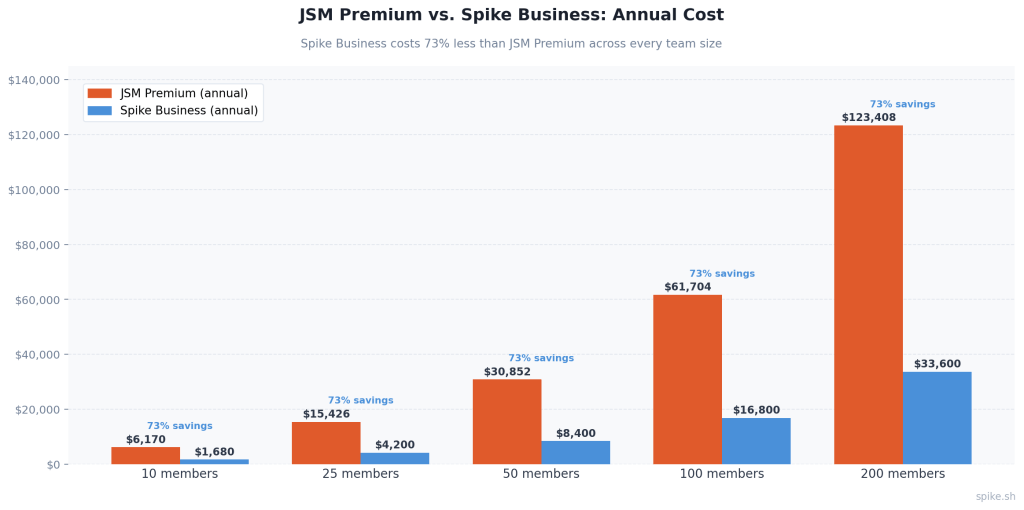
Spike Business costs 73% less than JSM Premium across every team size. And if you factor in the additional costs of Atlassian Guard and status pages on JSM, the savings with Spike are even higher.
Key point: Spike saves incident management teams 73% annually compared to JSM Premium. The gap grows further when additional costs like Atlassian Guard and status pages on JSM are included.
Is JSM worth it for incident management teams?
After going through the pricing tiers, hidden costs, and cost comparisons, the answer depends on what your team already uses and what you are trying to replace.
If your team is already deep in the Atlassian ecosystem (Jira Software, Confluence, and already paying for those seats), JSM is worth evaluating. The integration between JSM and Jira is tight. Incident tickets, change requests, and postmortems flow naturally into your existing Jira projects. The pricing is significant, but you are buying a platform your team already understands.
If you are migrating from OpsGenie and primarily need incident management and on-call alerting, JSM is over-engineered for your use case. You will pay Premium pricing ($51.42/agent/month) for ITSM capabilities you may never use. You will also run into the same limitations OpsGenie users had: no delivery channel control per escalation step, no built-in status page, and a more complex UI.
If you are looking for a dedicated incident management tool with workflows that match OpsGenie, Spike is the best option. It covers everything OpsGenie did, starts at $7/user/month, and costs 73% less than JSM Premium. OpsGenie users get 50% off their first six months.
The bottom line
JSM Standard costs nearly the same as OpsGenie Standard, but it is not a like-for-like replacement. Getting the features OpsGenie Standard included requires JSM Premium at $51.42/agent/month. Those features are post-incident analysis, stakeholder notifications, and meaningful data retention. Add Atlassian Guard for SSO, and the cost climbs further. Status pages require upgrading to Enterprise entirely.
For teams already deep in the Atlassian ecosystem, that investment may make sense. For teams that just need a dedicated incident management tool with familiar workflows, it is more than they need.
Spike covers everything OpsGenie offered. It starts at $7/user/month, and offers OpsGenie users 50% off their first six months. Also, it takes less than two hours to set up, and comes with a 14-day free trial.
Frequently Asked Questions (FAQs)
How much does Jira Service Management cost per month?
JSM has four plans priced per agent per month. Free is $0 for up to 3 agents. Standard is $20/agent/month. Premium is $51.42/agent/month. Enterprise pricing is custom and requires annual billing. For a 25-agent team, Standard costs $500/month, and Premium costs $1,285/month.
What is the difference between Jira and Jira Service Management?
Jira Software is a project and issue tracker for engineering teams managing sprints, bugs, and feature work. Jira Service Management is an ITSM platform for IT and operations teams handling service requests, incident management, and on-call alerting. They share a platform but are separate products with separate pricing.
Can I use Jira Service Management for free?
Yes. The Free plan supports up to 3 agents and includes on-call schedules, incident templates, and basic alerting. It is suitable for very small teams evaluating JSM. The 3-agent cap makes it unsuitable for most incident response teams.
What is the difference between JSM Standard and Premium?
JSM Standard ($20/agent/month) covers on-call scheduling, escalation policies, and basic alerting. It does not include post-incident analysis, stakeholder notifications, or meaningful alert data retention beyond 1 month. JSM Premium ($51.42/agent/month) adds all three, along with AIOps capabilities and a 99.9% uptime SLA. For OpsGenie migrators, Standard is not a like-for-like replacement. Premium is the minimum viable tier.
Does JSM include a status page?
No, not on Standard or Premium. Status pages are only available on Enterprise, which requires annual billing and custom pricing.
Does JSM include SSO?
No, not on Standard or Premium. SSO requires Atlassian Guard, a separate subscription at $4.20/user/month. For a 25-agent team, that is an additional $1,260/year. Enterprise includes SSO.
How does JSM pricing compare to OpsGenie?
OpsGenie Standard was $19.95/user/month. JSM Standard is $20/agent/month, nearly the same price. But JSM Standard drops post-incident analysis, stakeholder notifications, and alert data retention beyond 1 month, all of which OpsGenie Standard included. Getting those back requires JSM Premium at $51.42/agent/month, a 158% increase over OpsGenie Standard. Teams on OpsGenie Essentials ($9.45/user/month) face a 444% increase to reach JSM Premium.
Is JSM the right tool for OpsGenie migrators?
It depends on your setup. If your team already uses Jira Software and Confluence, JSM integrates tightly with those products and may be worth the cost. If you just need incident management and on-call alerting without the broader ITSM platform, JSM is over-engineered and significantly more expensive than OpsGenie was.
What is Spike and how does it compare to JSM for OpsGenie migrators?
Spike is a dedicated incident management and on-call platform. It covers on-call schedules, escalation policies, alert routing, and multi-channel notifications — the same workflows OpsGenie users are familiar with. It starts at $7/user/month and includes built-in status pages on every plan. JSM Premium costs $51.42/agent/month and does not include status pages below Enterprise. Spike costs 73% less than JSM Premium for the same team size. OpsGenie users also get 50% off their first six months on Spike.
What is the Atlassian Service Collection?
The Service Collection is a bundle Atlassian introduced in 2025 that packages JSM, Customer Service Management, Assets, and Rovo under one subscription. The per-agent pricing for JSM has not changed with this rebundle.